
Run the business
The numbers, from the source.
Reports read the same records the work happens in. Nothing is re-keyed, so the number on a report and the number on a job cannot disagree.
The three that matter
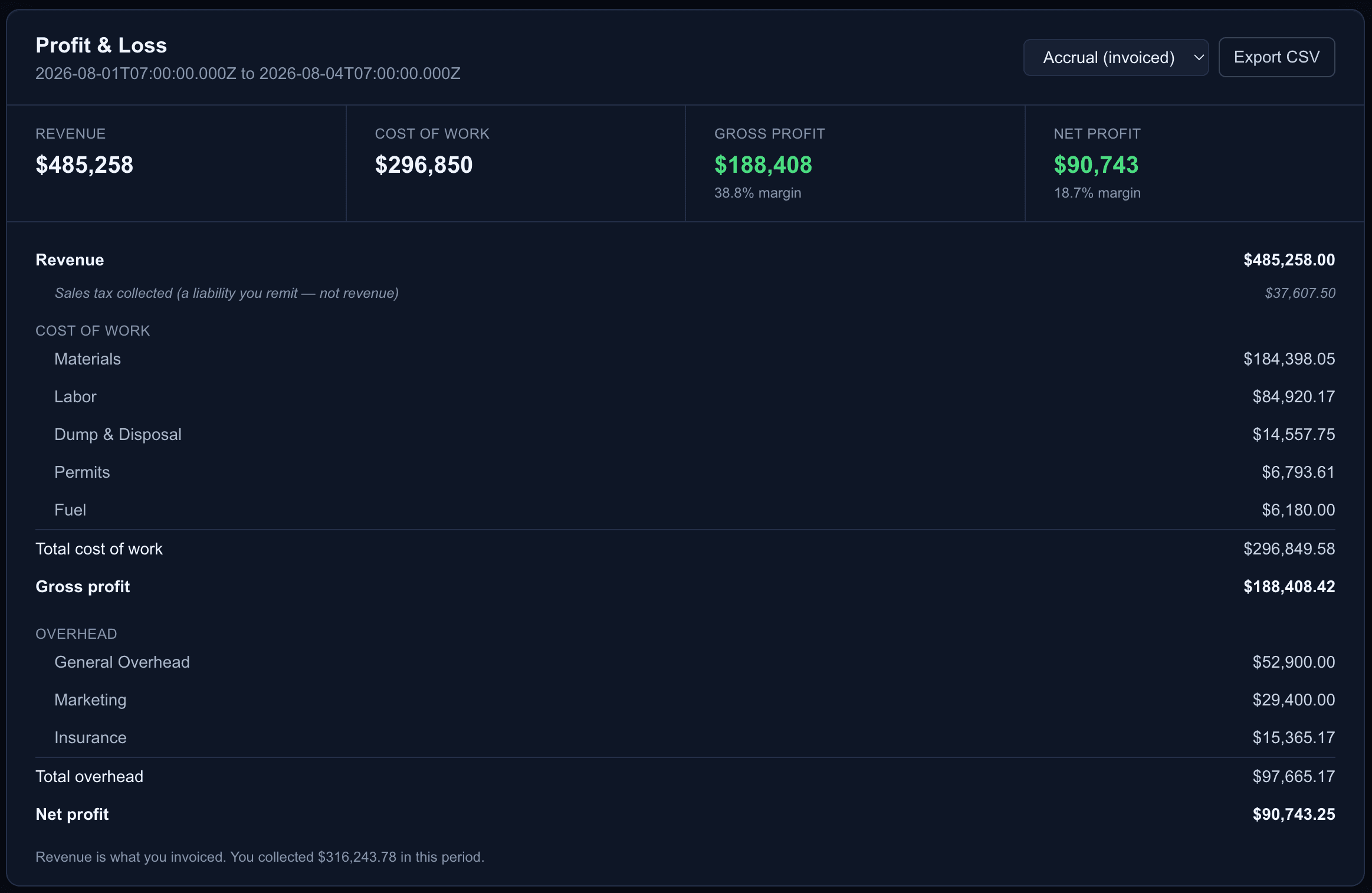
Pipeline by stage with value, sales by rep with contracts and revenue, and a P&L on a cash or accrual basis. Month, quarter or year.
- Pipeline: job count and value per stage
- Sales: revenue, contracts signed, appointments sat, per rep
- P&L: revenue net of tax, job cost, gross profit, overhead, net
Frozen periods
Closed months are snapshotted, so a report you ran in January still says in June what it said then. Late-arriving costs do not silently rewrite last quarter.
Who can see what
Profit and company financials are owner and admin only. A rep sees their own numbers. That is enforced on the server, not hidden in the interface.
Questions we get asked
- What reports are included?
- Four: sales pipeline by stage, sales performance per rep, canvassing performance, and a profit-and-loss statement. They are pre-built rather than a report writer you have to learn.
- Is the P&L cash or accrual?
- Both — it is a toggle. Accrual counts what you invoiced; cash counts what you actually collected in the period.
- Is sales tax counted as revenue?
- No. Sales tax is money you collect and remit, not money you earned, so it is shown outside revenue as the liability it is. Counting it as revenue is one of the most common ways a contractor's P&L flatters itself.
- Can a rep see company-wide numbers?
- No. The P&L and the company reports are owner and admin only. Reps see their own performance on the canvassing leaderboard and their sales goals.
Keep reading
Know what the job actually made.
Every cost that touches a job lands in one ledger: material, labor with burden, subcontractors, processing fees, commissions. Margin is then arithmetic, not opinion.
Commission that reads from the real number.
Plans built on revenue, gross profit or a flat amount — calculated from the same ledger the P&L uses. No parallel spreadsheet, no arguments at payday.
The playbook, where the work is.
SOPs nobody can find get ignored. Putting them beside the pipeline your team already opens is the difference between a document and a standard.
See it on your own jobs.
We'll walk your pipeline through it — your trades, your pricing, your crews — and you can tell us where it breaks.