
Run the business
AI that has read your jobs.
Not a chatbot bolted on the side. The AI here works against your measurements, your photos and your cost ledger — because generic advice about roofing is worth nothing.
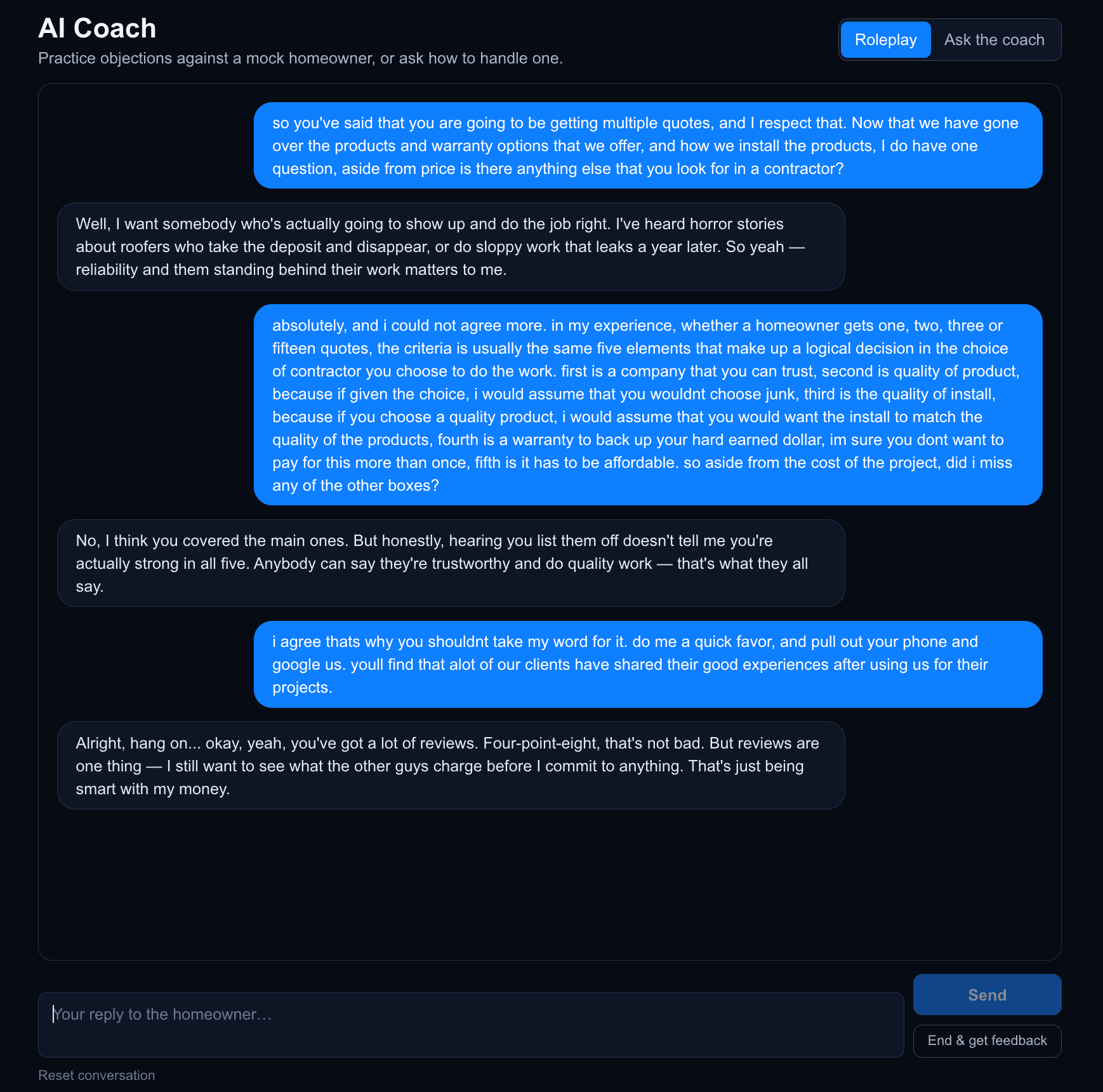
Coaching that argues back
A rep can practice against a homeowner who pushes back: price, spouse, other quotes, insurance. Or just ask how to handle the objection they hit this morning.
- Roleplay by trade, setting, objection and difficulty
- Straight answers when a rep just needs one
Reading what you already have
Takeoffs from uploaded plans, damage findings from job photos, a written proposal drafted from the estimate, and a profit advisor that reads the cost ledger and says where margin went.
- Plan takeoff into measurement fields
- Photo damage assessment by trade
- Proposal drafting from the estimate
- Profit advice from aggregates — never customer names or addresses
Spending you can see
Every AI call is metered per company with a monthly allowance, so cost is visible and bounded rather than a surprise at the end of the month.
Questions we get asked
- What does the AI actually do?
- Five things, all attached to work you are already doing: objection roleplay against a mock homeowner, plan takeoff into measurement fields, photo damage assessment by trade, proposal drafting from the estimate, and profit advice from your own numbers.
- Does customer data get sent to the AI?
- The profit advisor is sent aggregates and per-job margins only — never customer names or addresses. Where a feature does read a document or a photo you uploaded, it is because you asked it to analyse that specific file.
- Can we see what the AI costs?
- Yes. Usage is metered per company and visible, and each account has a monthly token allowance rather than an open-ended bill.
- Do we have to use the AI features?
- No. They are additive. Canvassing, estimating, signing, production, costing and reporting all work without them.
Keep reading
Measure once. The estimate prices itself.
Enter the roof measurements once and the quantities follow — squares, ridge, valley, starter, waste. Change a measurement and every line that depends on it updates, because the formula reads the measurement rather than a number someone typed.
Know what the job actually made.
Every cost that touches a job lands in one ledger: material, labor with burden, subcontractors, processing fees, commissions. Margin is then arithmetic, not opinion.
One pipeline, from knock to signature.
A job is one record for its whole life. The lead, the measurements, the estimate, the contract, the work order and the invoice all read from it — so nothing is re-entered and nothing disagrees.
See it on your own jobs.
We'll walk your pipeline through it — your trades, your pricing, your crews — and you can tell us where it breaks.