
Do the work
Production that reads from the job that was sold.
The work order is not a retyped version of the estimate — it is generated from it. Crews, materials, punch lists and QC all hang off the same job record.
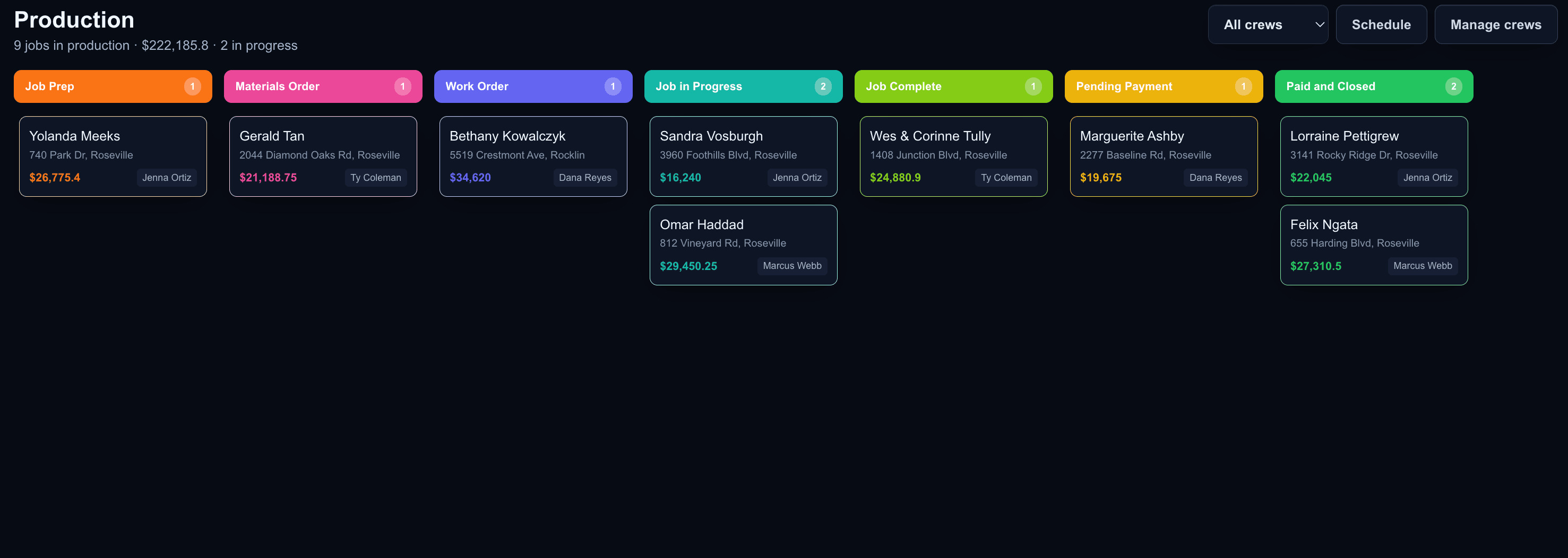
Boards for what is actually happening
A production view of every job in flight, by stage, so the office can see what is scheduled, what is waiting on material, and what is finished but not invoiced.
- Work orders with itemised scope
- Material orders with quantities from the estimate
- Crew assignment per job
Close the job properly
Punch lists and QC sign-off, so 'done' means someone checked. Photos and completion certificates attach to the job rather than living on a phone.
- Punch list items with owners and due dates
- Inspection reports and completion certificates as structured forms
- Before / progress / after photos on the job
Labor that reaches the P&L
A time clock that feeds job costing, so labor on a job is a number rather than an estimate. Wages exclude employer burden; job costing includes it, because the two are genuinely different figures.
Questions we get asked
- Is production a separate board from the sales pipeline?
- Yes. Production has its own view organised by production stage — job prep, materials, work order, in progress, complete, pending payment — so the office can see what is scheduled, what is waiting on material, and what is finished but not yet invoiced. Sales keeps its own board.
- Do work orders and material orders have to be typed up again?
- No. Signing an estimate drafts the invoice, the work order and the material order from the exact line items the customer accepted. Production reads the sale rather than re-entering it.
- Can we track punch list items and final inspections?
- Yes. Punch list items carry an owner and a due date, and inspection reports and completion certificates are structured forms on the job rather than loose paperwork.
- Does crew labour reach job profit?
- Yes. Time entries carry a wage rate and post to the job's cost ledger, so labour shows up in gross profit rather than disappearing into overhead. Payroll tax and workers' comp are added as burden on the costing side, because they are the employer's cost rather than the employee's pay.
Keep reading
Know what the job actually made.
Every cost that touches a job lands in one ledger: material, labor with burden, subcontractors, processing fees, commissions. Margin is then arithmetic, not opinion.
One schedule for appointments, crews and tasks.
Sales appointments and production work land on the same calendar, so the crew that has to be somewhere and the rep who promised it are looking at the same day.
Built for a roof, not a desk.
Reps and crews work where reception is worst. The app keeps working, saves to the phone, and syncs when signal returns — and tells you exactly what is still waiting.
See it on your own jobs.
We'll walk your pipeline through it — your trades, your pricing, your crews — and you can tell us where it breaks.