
Run the business
Commission that reads from the real number.
Plans built on revenue, gross profit or a flat amount — calculated from the same ledger the P&L uses. No parallel spreadsheet, no arguments at payday.
Plans that match your agreements
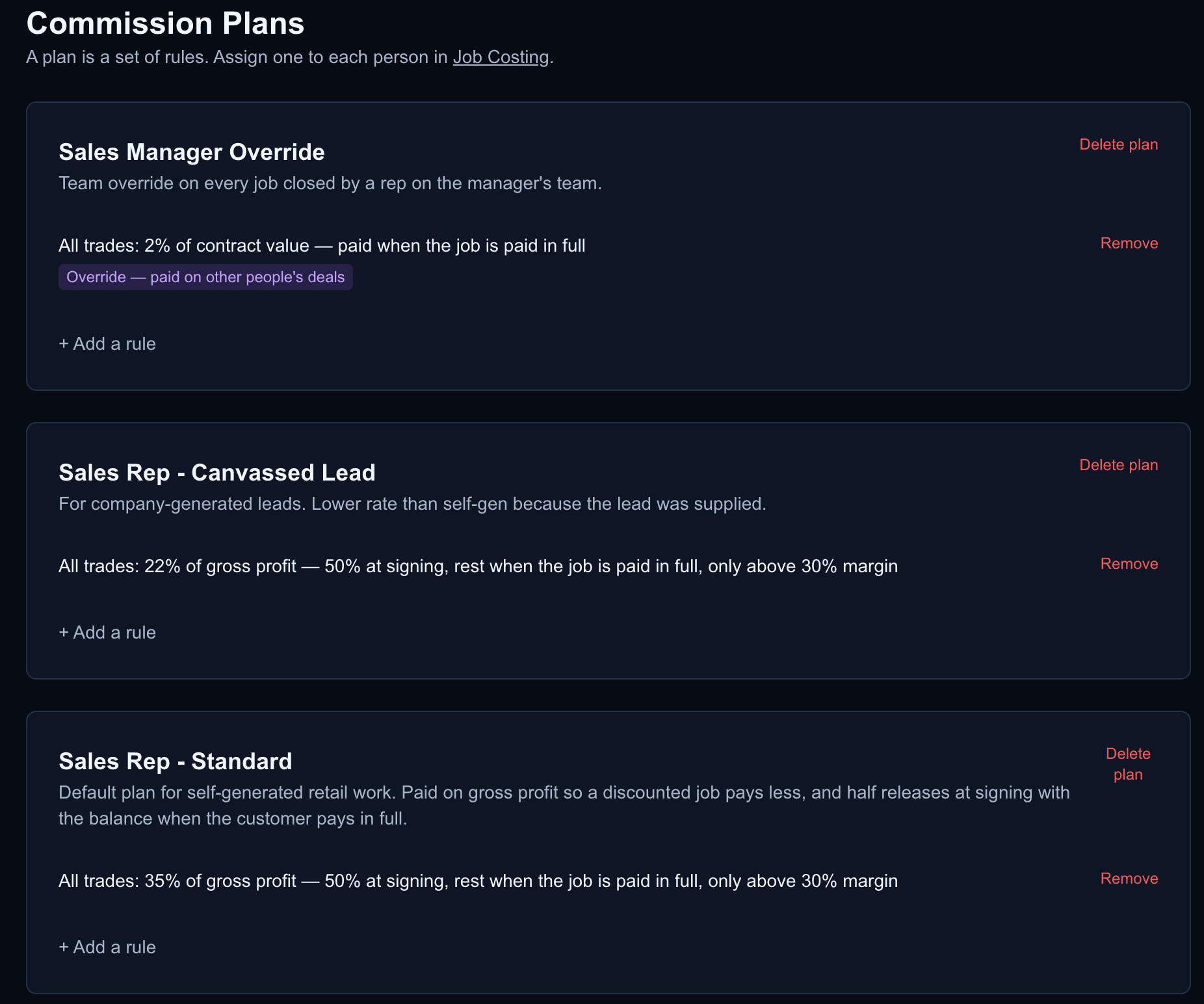
Front-end and back-end splits, tiers, thresholds, draws and split credit between reps. Assigned per person, so the new rep's plan and the veteran's can differ without a second system.
- Revenue, gross-profit or flat-amount bases
- Front-end on signing, back-end on completion
- Split credit with weights across multiple reps
It recalculates itself
Commissions recompute as jobs move, get paid, or change. Approved and paid entries freeze, so history does not rewrite itself — and a reversal is a visible negative line, never a quiet deletion.
Payouts your payroll can use
Approved commissions export as a vendor-neutral payout file. Payroll stays where it already is; this just stops the number being invented twice.
Questions we get asked
- Can we pay commission on profit instead of revenue?
- Yes. A rule's basis can be gross revenue, gross profit or a flat amount. Paying on gross profit is what makes a discount cost the rep something, which is usually the reason owners ask.
- What happens when a job changes after commission is calculated?
- It recalculates as the job moves, gets paid or changes. Entries that are already approved or paid are frozen, and a reversal is a visible negative line rather than a quiet deletion — so history does not rewrite itself.
- Can two reps split a job?
- Yes. Credit can be split across multiple reps with weights, and a manager override can be paid on top of deals closed by their team.
- Does it run payroll?
- No, and deliberately. It produces a payout batch your payroll provider can consume. Payroll is an integration rather than something we rebuild, so you keep whatever you already use.
Keep reading
Know what the job actually made.
Every cost that touches a job lands in one ledger: material, labor with burden, subcontractors, processing fees, commissions. Margin is then arithmetic, not opinion.
The numbers, from the source.
Reports read the same records the work happens in. Nothing is re-keyed, so the number on a report and the number on a job cannot disagree.
The playbook, where the work is.
SOPs nobody can find get ignored. Putting them beside the pipeline your team already opens is the difference between a document and a standard.
See it on your own jobs.
We'll walk your pipeline through it — your trades, your pricing, your crews — and you can tell us where it breaks.