
Run the business
Know what the job actually made.
Every cost that touches a job lands in one ledger: material, labor with burden, subcontractors, processing fees, commissions. Margin is then arithmetic, not opinion.
One ledger, every cost
Material orders, time entries, card fees and manual expenses all post to the same place, tagged to the job. Company overhead posts too, so the P&L is the whole business rather than the sum of the jobs.
- Automatic postings from material orders, the time clock and payment fees
- Receipt capture that pre-fills the form — and never writes to the ledger on its own
- Company overhead separated from job cost
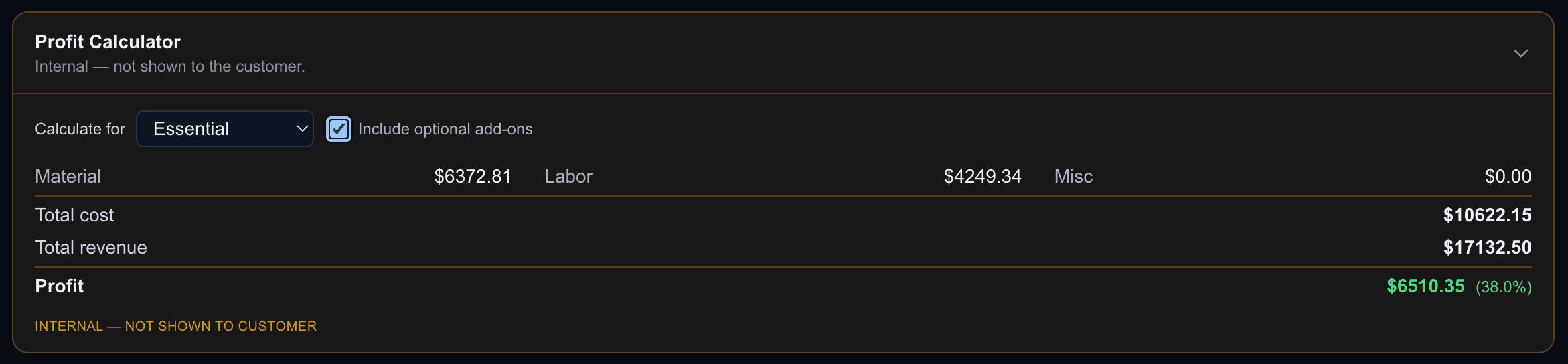
Profit you can defend
Gross profit per job, margin percent, and a P&L that reads from the same ledger on either a cash or accrual basis. Revenue is net of sales tax, because tax collected is money you owe, not money you made.
- Per-job gross profit and margin
- Company P&L, cash or accrual
- Sales tax held outside revenue where it belongs
QuickBooks, both directions
Purchases and bills pull in as costs; issued invoices push out as invoices. Your accountant keeps working the way they already do.
Questions we get asked
- Does receipt scanning post straight to the ledger?
- No, deliberately. It pre-fills the form for a human to confirm. A silently wrong total would corrupt job profit, the P&L and — through gross profit — a rep's commission.
Keep reading
Commission that reads from the real number.
Plans built on revenue, gross profit or a flat amount — calculated from the same ledger the P&L uses. No parallel spreadsheet, no arguments at payday.
The numbers, from the source.
Reports read the same records the work happens in. Nothing is re-keyed, so the number on a report and the number on a job cannot disagree.
Production that reads from the job that was sold.
The work order is not a retyped version of the estimate — it is generated from it. Crews, materials, punch lists and QC all hang off the same job record.
See it on your own jobs.
We'll walk your pipeline through it — your trades, your pricing, your crews — and you can tell us where it breaks.